Introduction to AI in Healthcare
Artificial intelligence is rapidly transforming numerous industries, and healthcare is no exception. AI’s capacity to analyze vast datasets, identify patterns, and automate tasks is leading to breakthroughs that improve patient outcomes, enhance efficiency, and reduce costs. From early disease detection to personalized treatment plans, AI is poised to revolutionize every aspect of healthcare delivery. This content piece will explore five key areas where AI is making a significant impact, highlighting its potential to reshape the future of medicine.


AI-Powered Diagnostics: Faster, More Accurate
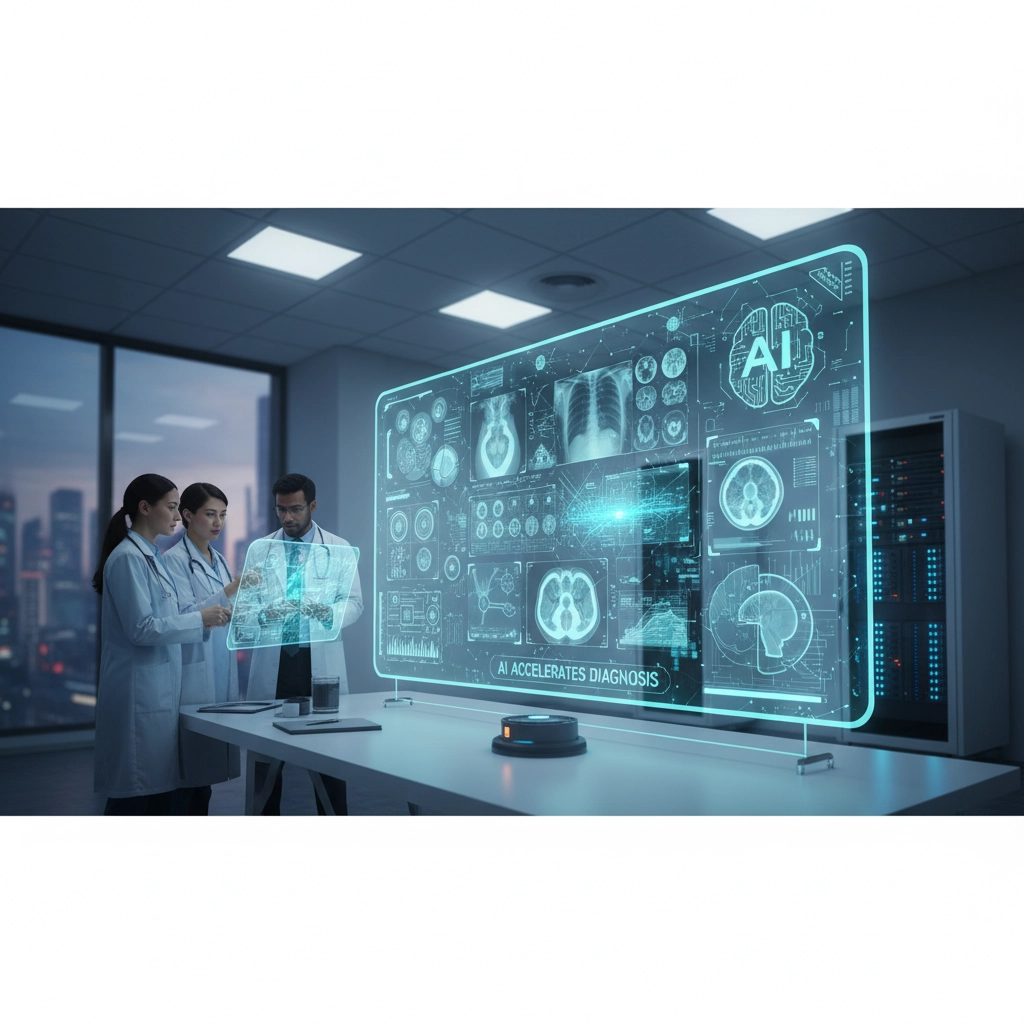
One of the most promising applications of AI in healthcare is in diagnostics. AI algorithms can analyze medical images, such as X-rays, CT scans, and MRIs, with remarkable speed and accuracy, often surpassing the capabilities of human radiologists. This is particularly valuable in detecting subtle anomalies that might be missed by the human eye, leading to earlier and more accurate diagnoses. For example, AI systems are being used to detect lung cancer from chest X-rays, identify diabetic retinopathy from retinal images, and diagnose skin cancer from dermatoscopic images. These AI-powered diagnostic tools not only improve diagnostic accuracy but also reduce the workload on healthcare professionals, allowing them to focus on more complex cases and patient care. Furthermore, AI can analyze pathology slides to identify cancerous cells, classify tumors, and predict treatment response, leading to more personalized and effective cancer therapies. The use of AI in diagnostics is continuously evolving, with new algorithms and applications emerging regularly, promising a future where diseases are detected and treated earlier than ever before.
Personalized Medicine: Tailoring Treatment to the Individual
AI is enabling the development of personalized medicine by analyzing vast amounts of patient data to tailor treatment plans to individual needs. This includes analyzing a patient’s genetic information, medical history, lifestyle, and environmental factors to predict their risk of developing certain diseases, determine the most effective treatment options, and monitor their response to therapy. For example, AI algorithms can analyze genomic data to identify genetic mutations that may affect a patient’s response to a particular drug, allowing doctors to choose the most effective medication and dosage. AI is also being used to develop personalized cancer therapies by analyzing the genetic profile of a patient’s tumor to identify specific targets for treatment. This approach allows doctors to select therapies that are most likely to be effective while minimizing side effects. Furthermore, AI can analyze patient data to identify patterns and predict which patients are most likely to benefit from certain interventions, such as lifestyle changes or preventative medications. The ability to personalize treatment plans based on individual patient characteristics has the potential to significantly improve patient outcomes and reduce healthcare costs. These advancements reflect how AI is transforming healthcare in profound ways.


Drug Discovery and Development: Accelerating the Process
The traditional drug discovery and development process is lengthy, expensive, and often unsuccessful. AI is accelerating this process by identifying potential drug targets, predicting the efficacy and safety of drug candidates, and optimizing clinical trial design. AI algorithms can analyze vast amounts of biological data, such as genomic sequences, protein structures, and chemical compounds, to identify potential drug targets and predict which compounds are most likely to bind to those targets and have a therapeutic effect. AI can also be used to predict the toxicity and side effects of drug candidates, helping to eliminate potentially harmful drugs early in the development process. Furthermore, AI can optimize clinical trial design by identifying the most appropriate patient population, predicting patient response to treatment, and monitoring patient safety. By streamlining the drug discovery and development process, AI has the potential to bring new treatments to market faster and at a lower cost. AI is also being used to repurpose existing drugs for new indications, which can significantly shorten the time it takes to develop new treatments for diseases.
Robotic Surgery: Enhancing Precision and Minimizing Invasiveness
Robotic surgery is another area where AI is making a significant impact. AI-powered robots can assist surgeons with complex procedures, enhancing precision, minimizing invasiveness, and reducing recovery times. These robots are equipped with advanced imaging and sensing technologies that provide surgeons with a magnified, three-dimensional view of the surgical site. AI algorithms can also analyze real-time data to guide the robot’s movements and provide surgeons with feedback on tissue properties and potential complications. Robotic surgery has been shown to improve outcomes in a variety of procedures, including prostatectomies, hysterectomies, and heart valve repairs. The use of AI in robotic surgery is continuously evolving, with new applications and technologies emerging regularly. For example, AI is being used to develop autonomous surgical robots that can perform certain tasks without human intervention, such as suturing and tissue dissection. While fully autonomous surgery is still in its early stages, it has the potential to revolutionize surgical care by improving efficiency, reducing costs, and making surgery more accessible to patients in remote areas. AI-driven robotic surgery is transforming the surgical field.


AI-Driven Virtual Assistants: Improving Patient Engagement
AI-driven virtual assistants are transforming patient engagement by providing personalized support, answering questions, and monitoring health conditions. These virtual assistants can communicate with patients through text, voice, or video, providing them with information about their medications, appointments, and test results. They can also monitor patients’ symptoms and vital signs, alerting healthcare providers to potential problems. AI-driven virtual assistants are particularly valuable for patients with chronic conditions, such as diabetes and heart disease, who require ongoing monitoring and support. These assistants can help patients manage their medications, track their diet and exercise, and provide them with personalized advice on how to improve their health. Furthermore, AI-driven virtual assistants can improve patient adherence to treatment plans by sending reminders, answering questions, and providing encouragement. By improving patient engagement and adherence, AI-driven virtual assistants can help to improve patient outcomes and reduce healthcare costs. These assistants are also being used to provide mental health support, offering patients a convenient and confidential way to access therapy and counseling.
Conclusion: A Healthier Future Powered by AI
AI is revolutionizing healthcare across a multitude of fronts, from enhancing diagnostic accuracy and personalizing treatment plans to accelerating drug discovery and improving patient engagement. The breakthroughs discussed here represent just a glimpse of the transformative potential of AI in medicine. As AI technology continues to advance, we can expect even more innovative applications that will further improve patient outcomes, reduce healthcare costs, and enhance the overall quality of care. While challenges remain, such as ensuring data privacy and addressing ethical concerns, the future of healthcare is undoubtedly intertwined with the continued development and integration of artificial intelligence. The journey toward a healthier future, powered by AI, is well underway.